
Ask an experienced restaurant general manager why they turned down an offer, and the answer is often not the salary. It is the bonus: a plan they did not understand, did not trust or did not believe they could ever hit. For owners and restaurant groups competing for senior operators, the restaurant general manager bonus structure is one of the most powerful and most underused parts of the offer. This guide sets out how to design one that attracts strong leaders and keeps them, with a focus on full-service, premium and multi-unit operators in Ontario and across Canada.
Why the bonus matters so much in restaurants
Restaurant economics leave little room for error. Restaurants Canada reports that the industry's average pre-tax profit margin is just 4.1%, and that 41% of restaurant companies are operating at a loss or just breaking even. In that environment, the GM's decisions on labour, purchasing, waste and guest experience show up directly in profit. A well-designed incentive gives the GM a reason to manage those levers like an owner. A poorly designed one either pays for luck or never pays at all.
The bonus is also a competitive signal. Senior roles in Canadian foodservice and hospitality increasingly advertise incentives up front. Sodexo Canada's Director, Operations role in the GTA lists a salary of $150,000 to $175,000 and states that it is eligible for an annual incentive bonus, and the St. Regis Toronto's Director of Food and Beverage posting lists $144,000 to $197,400 a year and marks the role as bonus eligible. Restaurant GMs moving up into multi-unit or director roles compare their offer against packages like these.
Start with base salary, then add the bonus
Every credible guide on this topic makes the same point. The Restaurant Association Metropolitan Washington's guide to an ideal restaurant management incentive plan says a management bonus plan is meant to give managers additional compensation, not replace their salary with variable pay, and that managers should always receive a competitive base. Toast's guide to restaurant manager bonus structure makes the same argument and warns that low base pay can discourage experienced candidates from applying.
For senior hires this is decisive. An experienced GM who is already well paid will not trade a secure base for a larger but uncertain bonus. Set the base against the real scope of the role: sales volume, covers, team size, number of outlets and how much the owner is involved day to day. Then build the incentive on top.
How big should the bonus be?
There is no published Canadian benchmark for restaurant GM bonus targets that we would cite, so the best public data is American. Black Box Intelligence's State of the Restaurant Workforce research on bonuses and benefits reports average GM bonus payouts as a percentage of base salary for 2024 of 16.2% in quick service, 12.9% in fast casual, 12.6% in family dining, 16.0% in casual dining and 26.3% in upscale casual and fine dining. Toast's guide describes a plan that lets managers earn up to an additional 20% of base salary as a common range, while noting that amounts vary by restaurant size and targets.
Treat those figures as direction, not a rule. What matters more to a senior candidate is whether the target is achievable, how it is calculated and whether the plan has a history of paying out.
Choosing the measures
The most common mistake is measuring too much. Three or four weighted measures that the GM can influence every week work better than a long scorecard. The usual building blocks are:
- Controllable profit or EBITDA. RAMW suggests EBITDA or prime cost as the financial KPI. Toast recommends basing profit bonuses on controllable profit, which excludes costs such as rent, depreciation and insurance that the GM cannot influence, and gives the example of Texas Roadhouse paying general managers 10% of store-level controllable profit.
- Prime cost. Food and beverage cost plus labour, which Toast says typically accounts for 60% to 65% of a restaurant's total expenses. A target that shares savings below an agreed ceiling rewards discipline without inviting the GM to cut quality.
- Guest and quality measures. Mystery shop scores, review ratings, inspection results and guest satisfaction.
- Team measures. Retention of key staff, training completion and internal promotions.
The balance is shifting toward guest and quality measures. Black Box reports that the share of brands using restaurant profit in GM bonus plans fell from 45.3% in 2023 to 31.7% in 2025, while quality metrics rose from 6.7% to 12.4% and guest feedback metrics from 5.3% to 8.0%. It also found that in full service, guest feedback and quality metrics were the bonus criteria most correlated with traffic growth, while in limited service it was unit revenue and unit profit. That is a useful guide: a fine dining or premium full-service GM should have a meaningful share of their bonus on guest and quality measures; a quick service GM can be weighted more heavily on unit results.
Thresholds, caps and timing
Three design choices decide whether the plan is trusted.
- A threshold or gate. Black Box recommends using thresholds to safeguard margin. A common design is that nothing pays unless the unit hits a minimum profit level, and above that the measures determine the payout. Explain the gate clearly; a hidden one destroys trust the first time it bites.
- A cap or a stretch tier. Decide whether exceptional results can earn more than the target. Senior operators are often attracted by an uncapped or high-ceiling stretch tier tied to profit above budget.
- Payout frequency. Toast argues that quarterly payouts maintain motivation better than annual ones in a high-turnover industry. Many groups pay part quarterly and hold part for an annual true-up, which also helps retention.
Whatever you choose, close the books on the same timeline every period and show the GM the calculation. Transparency is what turns a bonus from a line in the offer into a reason to stay.
Variations for multi-unit and owner-operated groups
For an area or multi-unit leader, the plan should combine results across the portfolio with a smaller share tied to the weakest unit, so the leader cannot ignore a struggling location. For an independent owner-operator hiring its first professional GM, simplicity matters most: one financial measure, one guest measure and a clear threshold. Growing groups sometimes add profit-sharing or equity for the GMs they want to keep for the long term. Our guides to multi-unit restaurant manager recruitment and quick service restaurant general manager recruitment cover the hiring side of those roles.
Explaining the plan in the offer
When you present the offer, show the candidate a worked example using last year's numbers: what the GM would have earned at target, below threshold and at stretch. Put the plan in writing, including the measures, weightings, threshold, payout dates and what happens if the GM resigns mid-period. For relocation, sign-on and the rest of the package, see our guide to a senior hospitality compensation package.
Frequently asked questions
Should a GM bonus be based only on profit?
Usually not. Profit should be part of it, but the US data shows brands moving weight toward guest and quality measures, which in full service are the criteria most linked to traffic growth.
Quarterly or annual?
Quarterly payouts keep the bonus visible. A split between quarterly payments and an annual true-up balances motivation with retention.
Do bonuses help with hiring, or only with performance?
Both. A clear, credible plan is often what convinces an employed GM to move.
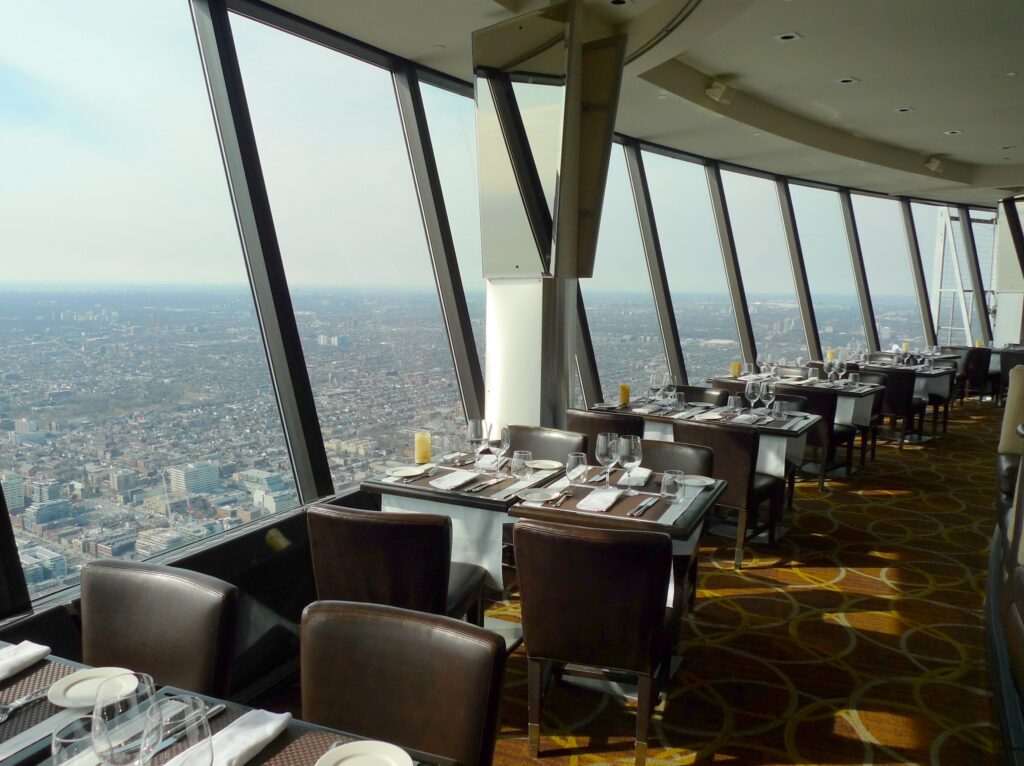
Hero image: "Inside 360 Restaurant (2)" by Larry Koester, via Wikimedia Commons, licensed under CC BY 2.0; cropped.

Current opening: Restaurant Manager, Toronto
Lecours Group has recruited hospitality leaders since 1991, in Toronto and across Canada first and selectively in the United States. We are currently recruiting a Restaurant Manager in Toronto (#10836), a leadership role for an operator who knows how to run the numbers and the floor. See the role and our other current openings on our find jobs page. Restaurant groups and owners designing a GM offer can find candidates with Lecours Group or contact our team to benchmark the incentive. You can meet our team and read more answers on our FAQs page.