
A Canadian restaurant or hotel group can spend heavily on systems and still leave operators with a point-of-sale that does not talk to delivery, a loyalty program that creates privacy risk, and guest apps that fail in French. Hospitality chief technology officer recruitment is the work of hiring the leader who can own that stack, and of deciding whether the gap is a CTO, a CIO, or a seat that wrongly tries to be both. The brief should be written before you start calling candidates.
This guide is for CEOs, boards and operators of Canadian restaurant and hotel groups hiring a chief technology officer or a closely related technology leader. It covers the CIO-versus-CTO choice, privacy rules for loyalty data, bilingual apps, and the point-of-sale and delivery stack. Lecours Group's hospitality recruiters look for technology leaders who can work with operators, not only with vendors.
Where this page fits
This page is about technology leadership in Canadian restaurants and hotels. Brand and demand leadership is a different seat, covered in our restaurant CMO recruitment in Canada guide. Keep that neighbouring page linked but distinct, so this brief stays on systems, data, privacy and the guest-facing stack.
Titles vary: Chief Technology Officer, Chief Information Officer, VP of Technology or Chief Digital Officer. Agree what the person will actually own — the point-of-sale, delivery integrations, loyalty platforms, property or restaurant systems, cybersecurity, vendors and the product roadmap — before you write the scorecard.
CIO or CTO: choose the gap before you choose the title
Wray Executive Search treats restaurant CIOs and CTOs together as technology leaders who now sit at the intersection of operations, guest experience, data, finance and growth, and who are expected to lead point-of-sale, digital ordering, loyalty, payments, cybersecurity and vendor management. That is a fair description of the work. It is not the same as saying every Canadian group needs both titles, or that the two jobs are interchangeable.
Hire a CIO-leaning leader when the gap is enterprise systems, security, privacy governance, integrations and the reliability of what operators already use. Hire a CTO-leaning leader when the gap is the product and the stack itself: the point-of-sale, the delivery connections, the guest apps, and the roadmap that will replace or unify them. Many mid-sized Canadian groups will hire one executive who covers both, but the brief should still say which problem is first. A search that asks for a strategist, a security officer and a hands-on product owner in the same sentence, without ranking them, produces a wish list rather than a hire.
What the Canadian brief has to include
Privacy rules for loyalty data
Loyalty programs collect personal information. The Office of the Privacy Commissioner of Canada, in its interpretation bulletin on personal information under PIPEDA, includes customer membership and account information in the context of frequent flyer or consumer loyalty programs among the examples of personal information in a business context, alongside consumer purchases and transactions. A hospitality CTO or CIO who cannot work with that fact is not ready for a Canadian loyalty stack.
The OPC's interpretation bulletin on form of consent states that the use and disclosure of information customized according to points-plan members' purchasing habits and preferences are likely sufficiently sensitive to warrant opt-in or positive consent. In March 2026, the OPC's findings on Loblaw's PC Optimum loyalty program underlined that personal information no longer required for its identified purposes should be destroyed, erased or made anonymous, and that if an organisation chooses to anonymize rather than destroy the data, it must be able to show there is no serious possibility of re-identification, alone or in combination with other available information. That case is about a retail loyalty program, not a hotel or restaurant, but the principles are the ones a Canadian hospitality technology leader will be expected to respect. Ask candidates who is accountable for consent, retention and vendor access in the loyalty platform they have run, and what they would change if they could not demonstrate anonymization.
Bilingual apps
Canadian restaurant and hotel groups that serve guests in English and French need ordering, booking and loyalty flows that work in both languages, not a late translation of an English product. The technology leader should be able to explain how they have staffed, tested and released bilingual guest or employee applications, and what they changed when a feature could not simply be copied from one language into the other. This is a product and operating requirement. It belongs in the scorecard even when the group's first language is English.
The point-of-sale and delivery stack
NRH Search's note on hospitality CTOs and tech leaders describes the modern point-of-sale as a central system, not a cash register, and argues that a dedicated CTO is needed to unify loyalty, direct ordering and third-party delivery so that those platforms connect to the kitchen and produce a single view of the guest. Whether or not a Canadian group uses the CTO title, the work is real: integrations fail, tickets are wrong, and guest data is split across vendors. Ask for evidence of a stack the candidate has actually simplified, including what they retired and how operators were trained.
Why these searches need discretion
- Strong technology leaders are usually employed. A public posting may alert vendors and competitors mid-contract.
- System changes are politically sensitive. Operators, franchisees and an incumbent IT leader may still be in place.
- Loyalty and guest data are confidential by law and by trust. The search itself should not become a data-risk conversation in public.
- The Canadian talent pool is finite. Informal enquiries travel among hospitality, retail and guest-technology executives.
Who recruits for this seat
Wray Executive Search specialises in restaurant CIO and CTO mandates, with an emphasis on point-of-sale, digital ordering, loyalty, payments, data, cybersecurity and franchise technology. NRH Search has written about rising demand for dedicated hospitality CTOs who can unify delivery, loyalty and the point-of-sale. Nobis Inc. recruits CIOs, CTOs and digital leaders for luxury and premium hospitality, as well as leaders inside hospitality technology companies, from offices in the United Kingdom and Estonia. Adastrum, a London firm, appoints digital and technology leadership around chief executives in hospitality, travel and leisure, and is retained-only. Those pages are useful market context. They are not Canadian salary surveys, and they are not a live vacancy at your group.
Lecours Group keeps the brief Canadian: PIPEDA-compliant loyalty data, bilingual apps, and the point-of-sale and delivery stack should be in the scorecard from the first conversation, not added after a shortlist appears.
How a confidential search should run
- Audit the stack. Review the point-of-sale, delivery connections, loyalty platform, privacy accountability and bilingual capability before writing the brief.
- Decide CIO versus CTO in writing. Name the first-year problem and the title that matches it.
- Map employed talent. Consider hospitality CTOs and CIOs, restaurant or hotel technology leaders, and adjacent retail or guest-technology executives with genuine multi-site evidence.
- Test judgement with real cases. Use a loyalty-privacy scenario, a failed delivery integration and a bilingual-release problem with the same materials for every finalist.
- Involve operations. A technology leader who cannot work with operators will not get the system adopted.
- Protect confidentiality. Limit names while vendor contracts or data issues are in motion.
Questions that reveal judgement
Ask a finalist to walk through a loyalty or guest-data decision that had to be changed because of privacy rules. What was collected, what consent was in place, and what did they stop doing? Follow with a stack example: a delivery or point-of-sale integration that was creating errors in the kitchen, and how they fixed it. Then ask how they have released or rebuilt a guest app in more than one language. References should include an operator or CEO as well as a technology colleague.
Common mistakes groups make
- Hiring a general IT director and calling the seat a CTO.
- Leaving loyalty privacy out of the brief until after a vendor is chosen.
- Treating French as a translation step at the end of a release.
- Allowing delivery, point-of-sale and loyalty to remain three disconnected systems.
- Letting every vendor, operator and board member give the candidate a different mandate.
Before interviews begin, decide whether the first year is about privacy and security, the point-of-sale and delivery stack, or guest-app quality. A candidate cannot rebuild all of those at once, and the panel should not pretend otherwise.
What compensation conversations should cover
A hospitality chief technology officer mandate may justify a substantial leadership package, but we do not publish Canadian figures without verified evidence. Discuss base, any performance arrangement, benefits and the travel or vendor-leadership reality of the role. Do not invent pay numbers, and do not import an American technology-leadership posting as a Canadian budget shortcut.
What a hospitality-rooted firm adds
Restaurant and hotel technology only works when the operators can run it and the guest data is handled lawfully. Lecours Group looks for leaders who hold the stack, privacy and the floor in the same brief. Review the hospitality clients we've placed for when considering organisations that trust us with senior appointments.
Start a confidential conversation
If you are planning a hospitality chief technology officer appointment in Canada, tell us about the mandate through our find candidates page. If you are exploring leadership opportunities, review our current openings. We are currently recruiting Restaurant Manager #10836 in Toronto; that is a current search, not this technology seat.
Our team has spent years recruiting senior leaders across Canadian hospitality. Meet our recruiters and see who would run your search.
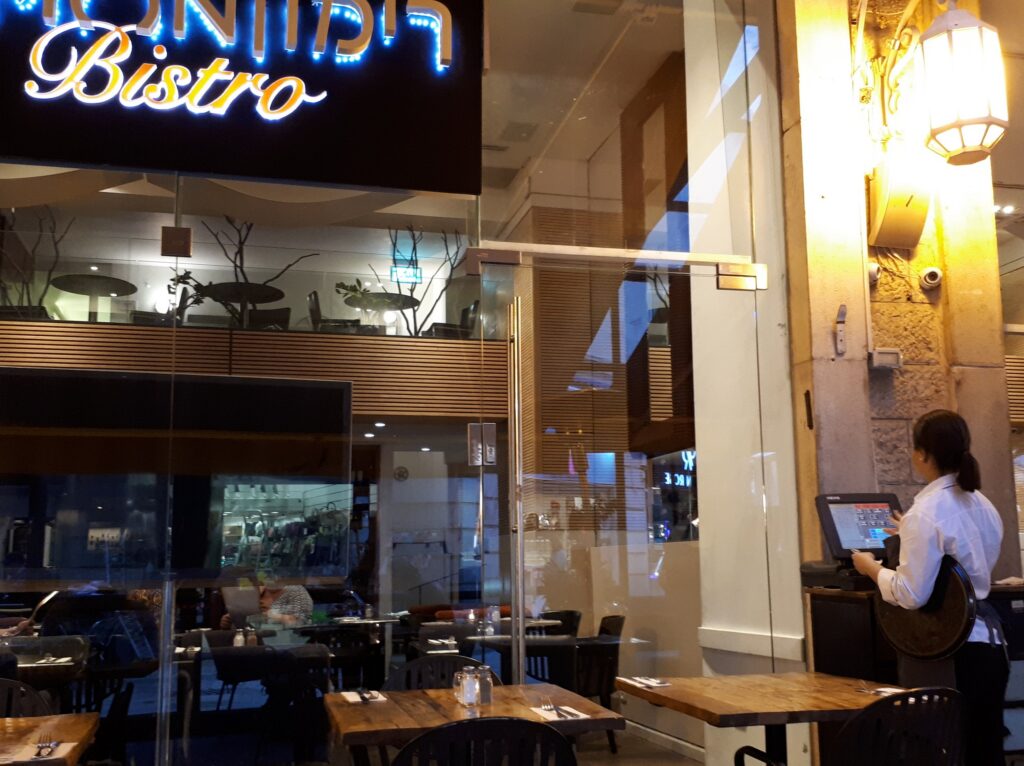
Photo: “Restaurant in Jerusalem - RIMON Bistro, Lunz St 4” by Rakoon, via Wikimedia Commons, licensed under CC0; unchanged. Illustrative restaurant point-of-sale setting only; not claimed as a Canadian location; no endorsement or client relationship implied.
