
A private club general manager interview often fails for a simple reason: the committee enjoys the conversation, compares impressions afterwards and then cannot explain why one finalist should be appointed over another. Private club general manager interview questions should test judgement under board, dining, membership and capital pressure, not only personality or a polished walk through the clubhouse. A recruiter's question bank for a Canadian club's committee groups the work by area and scores every answer on the same card.
This guide is for club presidents, boards and appointment committees assessing general-manager candidates at Canadian private clubs. It is not a job-seeker tip sheet. Lecours Group's hospitality recruiters use structured interviews so every finalist is measured against the same operating evidence. For compensation context on the seat itself, use our private club general manager salary page rather than turning this interview playbook into a second pay brief. For a related golf-club mandate, see our golf club general manager search in Ontario guide.
Where this page fits
This page is a question bank and a scoring method for interviewing a private club general manager. It does not publish pay figures, and it is not a geographic mandate brief. Keep those neighbouring pages linked but distinct, so this playbook stays on the interview.
If two interviewers leave the room with different definitions of "board-ready," the process will reward the candidate who mirrored the last person they met. Align the committee first.
Build the scorecard, then score every answer the same way
Do not invent criteria in the room. Agree in advance what this general manager must own in your club, then group the interview into four areas: board relations, food and beverage, membership, and capital and dues. Write those criteria down, assign a simple marking scheme, and make sure every interviewer uses the same card.
A practical method is a one-to-five score in each area, with a short evidence note under every mark. A three means a competent, relevant answer. A four or five requires a concrete example from a comparable setting, including what the candidate did and what changed. A one or two means the answer was vague or drawn from a room that does not resemble your club. Decide the weight of each area before the first conversation, write scores before the debrief, and do not let a single enthusiastic commenter override the card.
If you cannot explain why one finalist beat another on the four areas, you are not ready to make an appointment.
Questions that test board relations
A private club general manager has to work with a board whose composition changes, and with committees that sometimes drift into operations. The interview should test whether the candidate can give the board candid counsel without turning every meeting into a negotiation, and whether they can keep volunteer leaders focused on policy and direction.
Useful questions include:
- Walk us through a time the board was divided on an operating recommendation. What did you put in front of them, and how did you preserve trust with people who disagreed?
- How do you brief a new president or committee chair so the first six months do not become a second set of reporting lines?
- Describe a moment when a committee crossed from advice into day-to-day management. What did you do, and what did you ask of the chair?
- What information do you insist the board sees early, even when the news is unwelcome?
Listen for role clarity, not for charm with directors. A candidate who only talks about "keeping the board happy" has not told you how they will govern with you.
Questions that test food and beverage judgement
In most Canadian clubs, dining is where members decide whether the club still feels like their club. The general manager does not have to be the culinary lead, but they do have to protect member dining, events and the relationship between the clubhouse and the kitchen.
Useful questions include:
- How do you judge whether member dining is working, beyond whether a particular evening felt busy?
- Walk us through a time member dining and a large event were in the house on the same day. What did you refuse to compromise, and how did you back the culinary and clubhouse teams?
- How do you handle a cluster of member complaints about the same dining room without letting the loudest table redesign the menu?
- How do you support a culinary leader you did not appoint, and how do you decide when a dining problem is an operating problem rather than a personality problem?
The answers should show a general manager who can hold a standard across midweek member meals and peak event days. If every example comes from a room with no repeat clientele, treat that as a risk.
Questions that test membership judgement
Membership is not a sales contest with a different title. It is the club's community, wait-list, resignation pattern and culture. Ask how the candidate would attract the right members, keep existing ones engaged and tell the board the truth when usage or resignations are trying to say something.
Useful questions include:
- How do you read membership health besides the raw count: usage, resignations, proposals and the wait-list?
- Describe a time you had to tell a board that a popular idea would weaken the membership over time. What evidence did you use?
- How would you work with a membership committee and the clubhouse team so recruitment and retention are not left to one department?
- How do you handle a membership issue that is really a standards issue, without turning the general manager into a referee for personal disputes?
Listen for a method that respects the club's character, not only a plan to fill a roster.
Questions that test capital and dues judgement
Boards feel capital and dues decisions immediately, because members feel them immediately. The general manager has to translate building condition, reserve needs and operating pressure into choices the board can actually make, and then live with the standard those choices create.
Useful questions include:
- How do you prepare a board for a capital or dues discussion so the debate is about choices and consequences, not surprises?
- Walk us through a time you had to sequence capital work while keeping the club open and members reasonably patient. What did you defer, and why?
- How do you tell the difference between a project the club wants and a project the club cannot postpone?
- How do you communicate a difficult capital decision to members once the board has made it, and how do you keep the staff consistent in what they say?
Do not use the interview to extract a number. Test whether the candidate can frame trade-offs clearly and stand behind a decision after the meeting ends.
Who is already publishing interview material
Innovations Hospitality Search's guide to a strong private club general manager is a useful employer-facing look at leadership contexts, board partnership and member experience, written from a US practice. AAMCN's club manager interview list offers six common questions with sample answers, aimed as much at job seekers as at employers, and written for a generic venue rather than a Canadian member-owned club. MockInterviewPro's golf club manager interview questions are a candidate-facing practice set, with sample answers and coaching prompts. Those pages are useful as market context. None of them is a recruiter's question bank for a Canadian club committee, grouped by those four areas, with a method for scoring the answers. That is the work this page is for.
Common mistakes committees make
- Running a friendly dinner and an unstructured conversation, then arguing about "fit."
- Asking every candidate a different set of questions.
- Letting one director's favourite topic crowd out membership or capital.
- Scoring after the group discussion, once the loudest voice has already landed.
- Making an appointment before references have been checked against board, dining and membership evidence.
A strong general manager will not wait indefinitely while the committee debates notes it never wrote down. Finish the scorecard and decide.
What compensation conversations should cover
Compensation belongs in a prepared conversation once mutual interest is clear. We do not publish Canadian pay figures in this guide; that context sits on our private club general manager salary page. Discuss base, any performance arrangement, benefits, and the real expectations around board meetings, events and after-hours work. Keep the interview about operating evidence first so the process does not collapse into a negotiation before you know who can actually lead the club.
What a hospitality-rooted firm adds
Lecours Group helps clubs turn a vague "good with members, good with the board" brief into a scored interview that covers the work the general manager will actually do. Review the hospitality clients we've placed for when considering organisations that trust us with senior club appointments.
Start a confidential conversation
If you need help designing private club general manager interview questions or conducting a confidential process, tell us about the mandate through our find candidates page. If you are exploring leadership opportunities, we are currently recruiting a Director of Culinary / Executive Chef for a private golf and country club in London, Ontario. Review that search and our other current openings. That culinary mandate is a live example of a senior club search, not a general-manager vacancy. This guide is not itself a vacancy advertisement.
Our team has spent years assessing club and hospitality leaders across Canada. Meet our recruiters and see who would support your process.
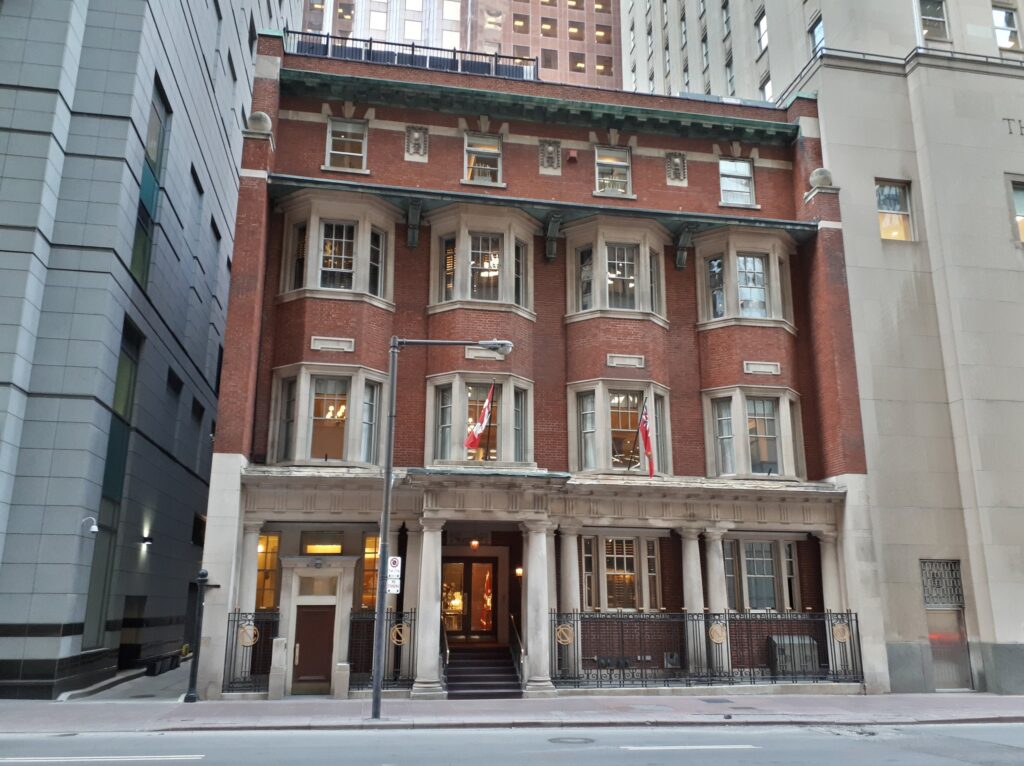
Photo: “The National Club, Toronto” by Oaktree b, via Wikimedia Commons, licensed under CC BY-SA 4.0; unchanged. Illustrative Toronto private club setting only; no endorsement or client relationship implied.
